





|
|
|
|
|
|
  |
|
 |
                   
|
|
Geert Hofstede™ Cultural Dimensions
* Description for each of Hofstede's Dimensions listed below
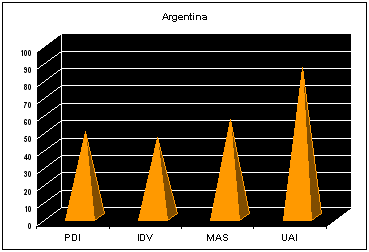
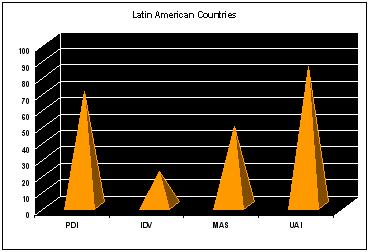
Argentina is similar to many of the Latin American countries in analysis of the Hofstede Dimensions (see Latin America Hofstede Graph below). In reviewing the data, there appears to be a correlation between Argentina’s culture and religion, as explained below.
The high Uncertainty Avoidance Index (UAI) ranking of 86 indicates the society’s low level of tolerance for uncertainty. In an effort to minimize or reduce this level of uncertainty, strict rules, laws, policies, and regulations are adopted and implemented. The ultimate goal of this population is to control everything in order to eliminate or avoid the unexpected. As a result of this high Uncertainty Avoidance characteristic, the society does not readily accept change and is very risk adverse.
* Average rankings of all Hofstede Latin Countries
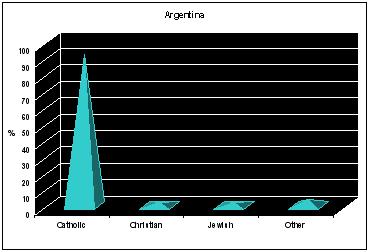
In many of the Latin American countries, including Argentina, the population is predominantly Catholic (see Religions Graph below). The combination of Catholicism and the cultural dimensions shown in the Hofstede Graph above, reinforce a philosophy predicated in the belief that there is an absolute ‘Truth”. As Geert Hofstede explains about peoples with a high Uncertainty Avoidance Index, their attitude is, “There can only be one Truth and we have it.”
The World Factbook 2002
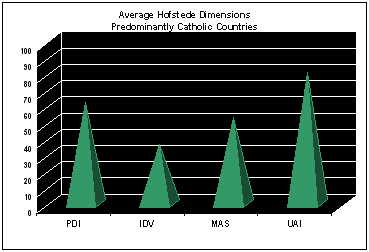
In a country that has over 50% of its population practicing the Catholic religion, we found the primary correlating Hofstede Dimension to be Uncertainty Avoidance (UAI). There were only 2 countries out of 23 that did not follow this correlation, they were Ireland and the Philippines. (See accompanying Article)
Based on our studies and data, the large majority of predominantly Catholic countries (those with Uncertainty Avoidance as their highest ranking Dimension) have a low tolerance for ambiguity. This creates a highly rule-oriented society that institutes laws, rules, regulations, and controls in order to reduce the amount of uncertainty within the population.
* * * Power Distance Index (PDI) focuses on the degree of equality, or inequality, between people in the country's society. A High Power Distance ranking indicates that inequalities of power and wealth have been allowed to grow within the society. These societies are more likely to follow a caste system that does not allow significant upward mobility of its citizens. A Low Power Distance ranking indicates the society de-emphasizes the differences between citizen's power and wealth. In these societies equality and opportunity for everyone is stressed.
Individualism (IDV) focuses on the degree the society reinforces individual or collective achievement and interpersonal relationships. A High Individualism ranking indicates that individuality and individual rights are paramount within the society. Individuals in these societies may tend to form a larger number of looser relationships. A Low Individualism ranking typifies societies of a more collectivist nature with close ties between individuals. These cultures reinforce extended families and collectives where everyone takes responsibility for fellow members of their group.
Masculinity (MAS) focuses on the degree the society reinforces, or does not reinforce, the traditional masculine work role model of male achievement, control, and power. A High Masculinity ranking indicates the country experiences a high degree of gender differentiation. In these cultures, males dominate a significant portion of the society and power structure, with females being controlled by male domination. A Low Masculinity ranking indicates the country has a low level of differentiation and discrimination between genders. In these cultures, females are treated equally to males in all aspects of the society.
Uncertainty Avoidance Index (UAI) focuses on the level of tolerance for uncertainty and ambiguity within the society - i.e. unstructured situations. A High Uncertainty Avoidance ranking indicates the country has a low tolerance for uncertainty and ambiguity. This creates a rule-oriented society that institutes laws, rules, regulations, and controls in order to reduce the amount of uncertainty. A Low Uncertainty Avoidance ranking indicates the country has less concern about ambiguity and uncertainty and has more tolerance for a variety of opinions. This is reflected in a society that is less rule-oriented, more readily accepts change, and takes more and greater risks.
Geert Hofstede Dimensions Analysis Charts are located in each Country's page listed on the left.
Business Etiquette and Manners are located in each Country's page listed on the right, plus many additional web site links and resources applicable to that Country.
|
|
|
|
***
   
Click on a country for its Business Etiquette Africa
|
|
 |





 .
. .
.
. .